Introduction:
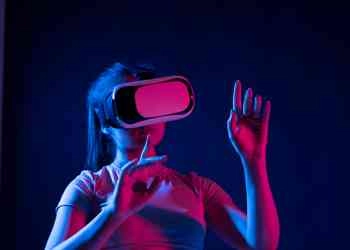
- the revolutionary role that Augmented Reality (AR) and Virtual Reality (VR) play in reshaping medical education for enhanced learning experiences.
1. AR and VR Basics in Medical Education:
- Introduction to AR and VR technologies and their applications in medical training.
- Overview of how these immersive technologies create interactive and realistic learning environments.
2. Anatomy and Surgical Simulation:
- Use of AR and VR for immersive anatomy exploration and virtual surgical simulations.
- Enhancing hands-on experience and spatial understanding for medical students.
3. Patient Interaction and Communication Skills:
- Applications of AR and VR in developing effective communication skills with virtual patients.
- Simulated scenarios for practicing bedside manners and patient interaction.
4. Diagnostic Training and Medical Imaging:
- Integration of AR and VR for diagnostic training through interactive medical imaging.
- Enhancing interpretation skills and providing a dynamic learning experience for radiology and imaging studies.
5. Virtual Medical Laboratories:
- Utilization of VR for creating virtual laboratories for medical experiments and research.
- Safe and realistic environments for hands-on experimentation and exploration.
6. Remote Learning and Telemedicine:
- AR and VR solutions for remote medical education and telemedicine training.
- Bridging geographical gaps and facilitating collaborative learning in a virtual space.
7. Surgical Planning and Simulation:
- Incorporation of AR and VR in surgical planning and preoperative simulations.
- Enhancing precision and preparedness for complex surgeries through virtual rehearsal.
8. Mental Health Training and Empathy Building:
- VR applications for training healthcare professionals in understanding mental health conditions.
- Building empathy through immersive experiences to enhance patient care.
9. Collaborative Learning Environments:
- Creation of collaborative AR and VR spaces for group learning and interdisciplinary interactions.
- Encouraging teamwork and shared decision-making in virtual healthcare scenarios.
10. Continuous Professional Development (CPD):
- Implementation of AR and VR for ongoing medical education and continuous professional development.
- Keeping healthcare professionals updated with the latest advancements and best practices.
Conclusion:
- Recap of the transformative impact of AR and VR in medical education.
- Encouragement for medical institutions to embrace these technologies for immersive, effective, and dynamic learning in the field of healthcare.
Comments (13)

Veer Thakkar
Student
26 Apr 2023 | 15:46
very good blog and so knowledgeable

Rehaan Malik
Student
27 Feb 2023 | 16:56
Congratulations for a blog that is a good example of AR VR technologies

Diksha
Student
4 Feb 2023 | 13:05
Thank you for making complex topics so accessible

Ira Malhotra
Student
3 Jun 2023 | 15:50
Thanks on making the complexities of AR and VR accessible in medical education. Your blog is a great guide for us

Ankit Tiwari
Student
28 May 2023 | 16:27
This blog is a fantastic resource. Well done

Rian Patel
Student
23 May 2023 | 17:37
The clarity in your writing makes this complex topic accessible to all readers

Isha
Student
22 May 2023 | 17:06
Engaging in virtual discussions has been a highlight of my online learning. The sense of community it creates truly enhances the overall educational experience."

Saisha Mehra
Student
2 May 2023 | 17:34
An engaging blog through the transformative power of AR and VR in medical education

Krish Khanna
Student
7 Apr 2023 | 12:09
informative blog good to read it

Aaryan Sinha
Student
13 Mar 2023 | 17:19
its very informative blog

Anaya Sharma
Student
18 Apr 2023 | 19:16
Fascinating blog on AR and VR in medical education! Summarizes the transformative role of immersive technologies

Aakash Chauhan
Student
19 Mar 2023 | 11:35
Interesting study on AR and VR in medical education! A brief insight into the wide world of augmented and virtual reality

Categories
Recent posts


Biometric Authentication: The Future of ...
13 Jan 2024
ChatGPT
15 Nov 2023
Navigating the Digital Classroom: Tips ...
9 Aug 2023


Nice blog that highlights the unprecedented integration of AR and VR in medical education